
Warrington Township Resident Lookup Records
A resident lookup has to fit the fact being checked. The Bucks County tax search can identify the current tax-side owner, parcel, property location, mailing lines, assessed value, and deed book/page. A recorded instrument establishes transfer parties and a legal description. Pennsylvania's voter service is for an individual to confirm registration status, while a court docket can provide a public case trail. Birth and death records instead document events under separate custody and eligibility rules. None of those sources is a complete list of everyone who lives at an address.
| Record | What it confirms | Where | Access |
|---|---|---|---|
| Tax/property card | Tax-side owner, parcel, situs, mailing line, and deed pointer | Bucks County Tax Claim search | Public web search; not a household roster. |
| Recorded instrument | Transfer parties, recording history, and legal description | Bucks Recorder or LANDEX | LANDEX fee service or Recorder research room. |
| Voter status | An individual's registration-status confirmation | Pennsylvania voter service | Person-facing confirmation, not a public browse tool. |
| Court docket | Public case identifiers, parties, events, and status where released | UJS Case Search | Restricted classes and some court material are excluded. |
| Vital record | A birth or death event when access rules are met | Pennsylvania Department of Health or State Archives | Date, relationship, and record type control access. |
Start with the most direct record. A known property address belongs in the County tax search. A known case lead belongs in UJS. A known birth or death event belongs with the state custodian. Keeping those paths separate makes a Warrington Township resident lookup more accurate and reduces the chance of treating a mailing address, a docket, or an old event as proof of present residence.
Warrington Township Property Lookup
For a current property lead, use the Bucks County Tax Claim search. Its Owner field supports surname-first entries such as “Smith John” or “Smith, John.” When the address is known, enter only the house number and street in Location Address. City and ZIP are separate fields, and the municipality selector includes Warrington Twp. Those form details matter because the location box is not a general mailing-address search.
The returned card can show the parcel number, property location or situs, municipality, school district, assessed value, current owner, three mailing-address lines, deed book/page, and delinquent-tax fields. Read each field for its own purpose. The situs is the taxed parcel, and a mailing line is where tax correspondence goes. A post-office box, representative address, or another property can appear there, so it does not establish who occupies the property. Carry the parcel number and deed pointer forward when the next check is a recorded transfer.
Warrington Township Court Lookup
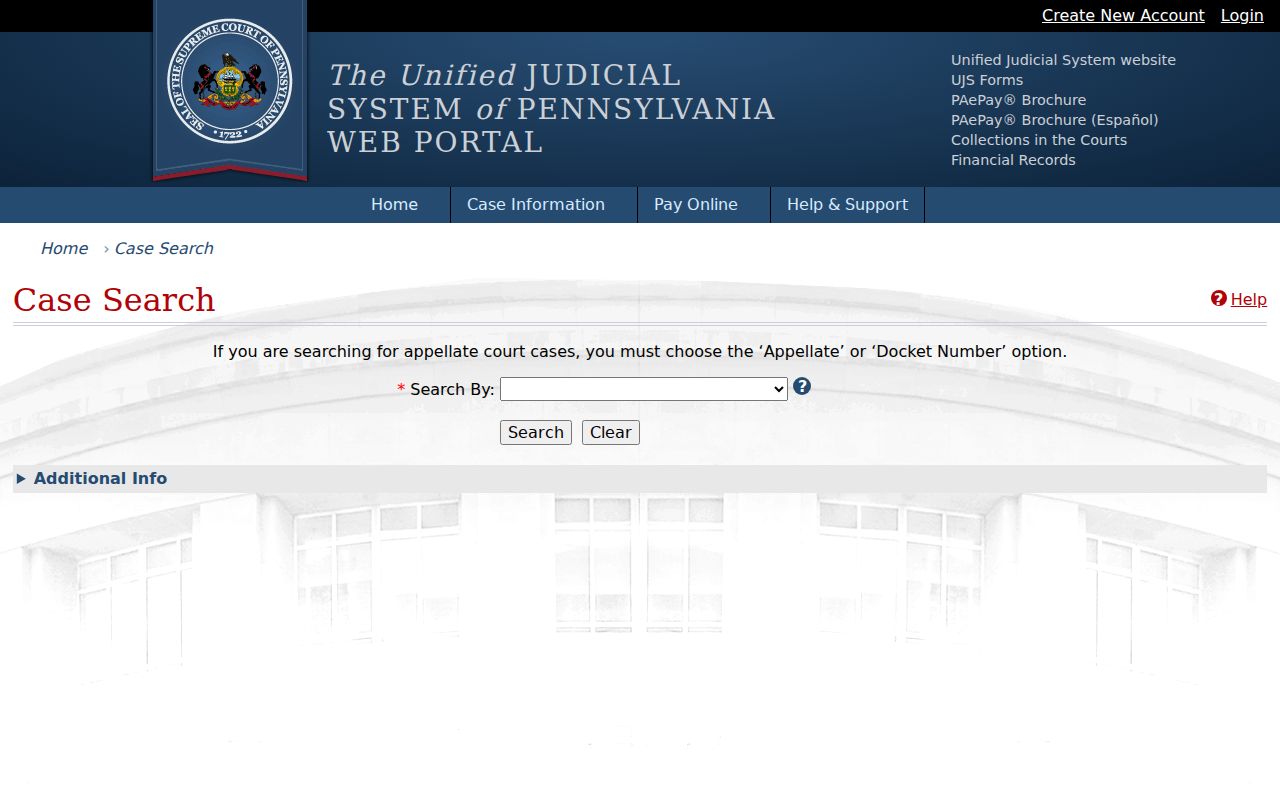
The public name route is Pennsylvania UJS Case Search. Its Search By menu includes Participant Name, docket number, date filed, citation number, complaint number, incident number, parcel, organization, and other modes. For a person, select Participant Name, use the surname with an optional given name, then narrow by Bucks County and a date range when the selected search mode allows it. The portal's official help notes that fields and results vary by mode.
A UJS result can provide a docket number, court and county, case category, filing date, participant names and roles, events or docket entries, disposition or status when public, and financial or filing information where that record class permits it. Compare the county, date, role, and case number before treating a same-name result as a match. Juvenile matters, expunged matters, Act 5 limited-access cases, and other restricted material are excluded. Public Case Search also does not cover civil Court of Common Pleas dockets in the same way as the public categories it lists.
The UJS Case Search screen is shown here for the court portion of a Warrington Township resident lookup.
County court offices are the route for formal copies and questions about material unavailable online. Federal cases are separate and use PACER, not UJS. The systems should be compared by court and case number rather than treated as interchangeable name databases.
Compare Court Search Systems
UJS, Bucks County court access, and PACER serve separate court systems. UJS is the statewide public Case Search starting point for qualifying Pennsylvania matters. Bucks County offices handle local filing, copy, and access questions under court policies rather than an ordinary Right-to-Know request. PACER is the federal docket system, including the Eastern District of Pennsylvania. A result or no-result in one route does not establish what another system holds.
Use the court, county, case number, filing date, and party role to compare records. That is more reliable than merging same-name results across state and federal systems.
Verify Warrington Township Resident Records
Verify a person with independent details, not with a shared surname. Preserve the spelling each office uses, then compare a parcel or situs, middle initial or suffix, Bucks County, date range, recorded instrument number, court docket number, or event date. The purpose is to distinguish two people who look alike in a search result. A property card may give the parcel anchor, while a court record may supply the case and party role. Vital material can support an event only when its access rules allow it.
- Search the County tax card by the known address or surname-first owner entry. Save the parcel number, situs, and deed book/page exactly as returned.
- Use the deed reference to request or retrieve the recorded instrument, then compare named parties, recording date, and legal description.
- Run a Participant Name search in UJS with Bucks County and an appropriate date range. Separate identical names by case number and party role.
- For a birth or death event, follow the Department of Health or archive route that fits the date and applicant eligibility. Request a certified copy only from the custodian.
- Docket
- The court's running case record, identified by a case number and containing entries or events that are public when released.
- Index and image
- An index points to a record. An image is the scanned document or record view, which may have a separate access path or fee.
- Certified copy
- A custodian-issued copy with the certification required for uses that need an official record, not a general search result.
Warrington Township Voter Status
Pennsylvania's registration-status service is designed for a person to confirm an individual record. The live service uses a name-identification path and date-of-birth information, with County used to narrow a record when the form asks for it. It is not a Warrington Township resident lookup that allows visitors to browse a street or compile a neighborhood roster.
The official voter-list request process is different. Its products include a Street List and other defined public-file products, but the request form requires the statutory-use attestation under 25 Pa.C.S. §§ 1207(b) and 1404(c)(2). Protected addresses, sensitive application material, and ballot choices are not open street-list information. For a registration question, use the person-facing status route. For an authorized request, identify the needed product and geographic scope to the official election office.
Note: Participation history can indicate that a voter participated in an election, but it does not reveal ballot choices.
Warrington Township Vital Record Dates
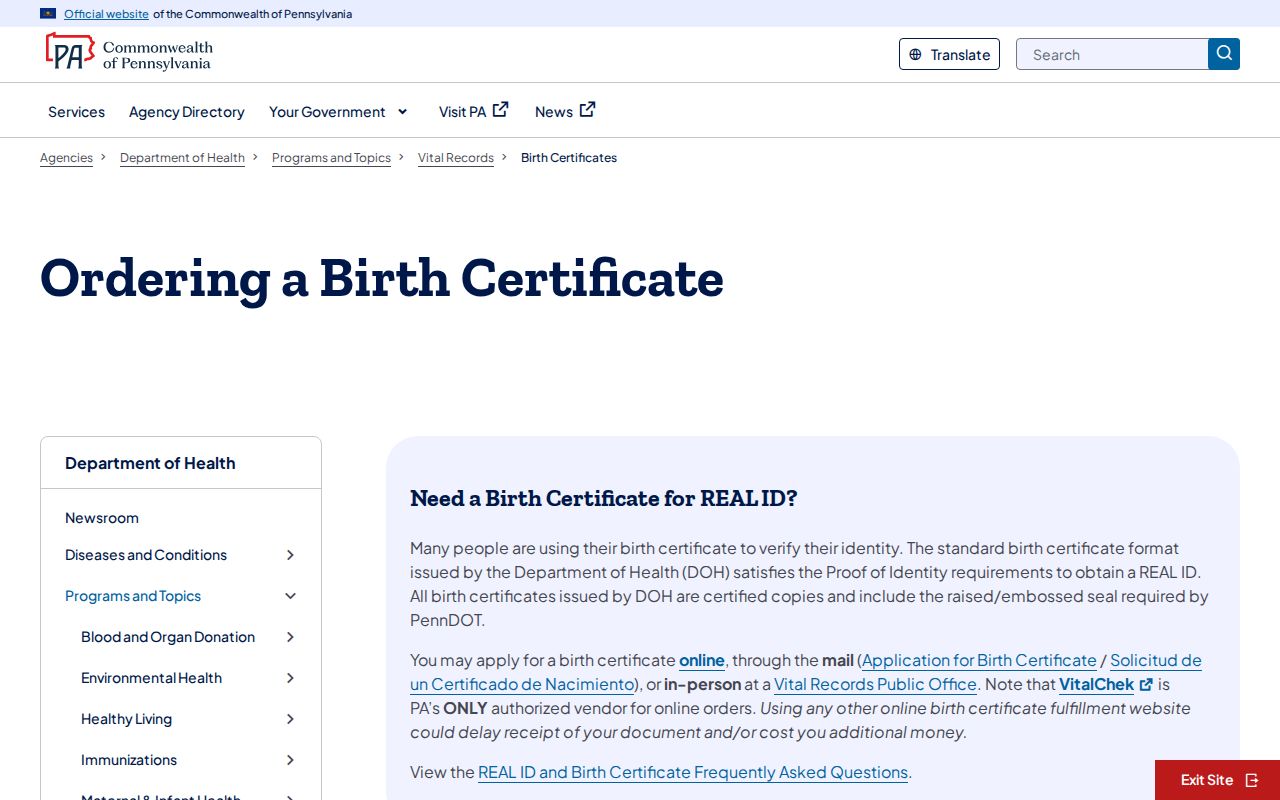
Vital records are date-led, not address-led. Pennsylvania's Division of Vital Records keeps birth and death records from 1906 forward. A birth certificate is confidential for 105 years. The Department identifies eligible relatives and representatives, requires qualifying signed identification, and states that a person must be 16 to request by mail or in person and 18 to use the online route. The Department lists a $20 birth-certificate fee and a stated $10 online service charge.
The Pennsylvania birth-certificate route shows the modern request path for an eligible applicant.
Death certificates have a 50-year confidentiality period. Follow the Department's death-certificate instructions for current relationship, identification, and delivery rules. Bucks marriage applications and copies are held through the Bucks Register of Wills and Clerk of the Orphans' Court, while divorce information belongs with the appropriate court file.
The Pennsylvania death-certificate page identifies the state route for a dated death-record request.
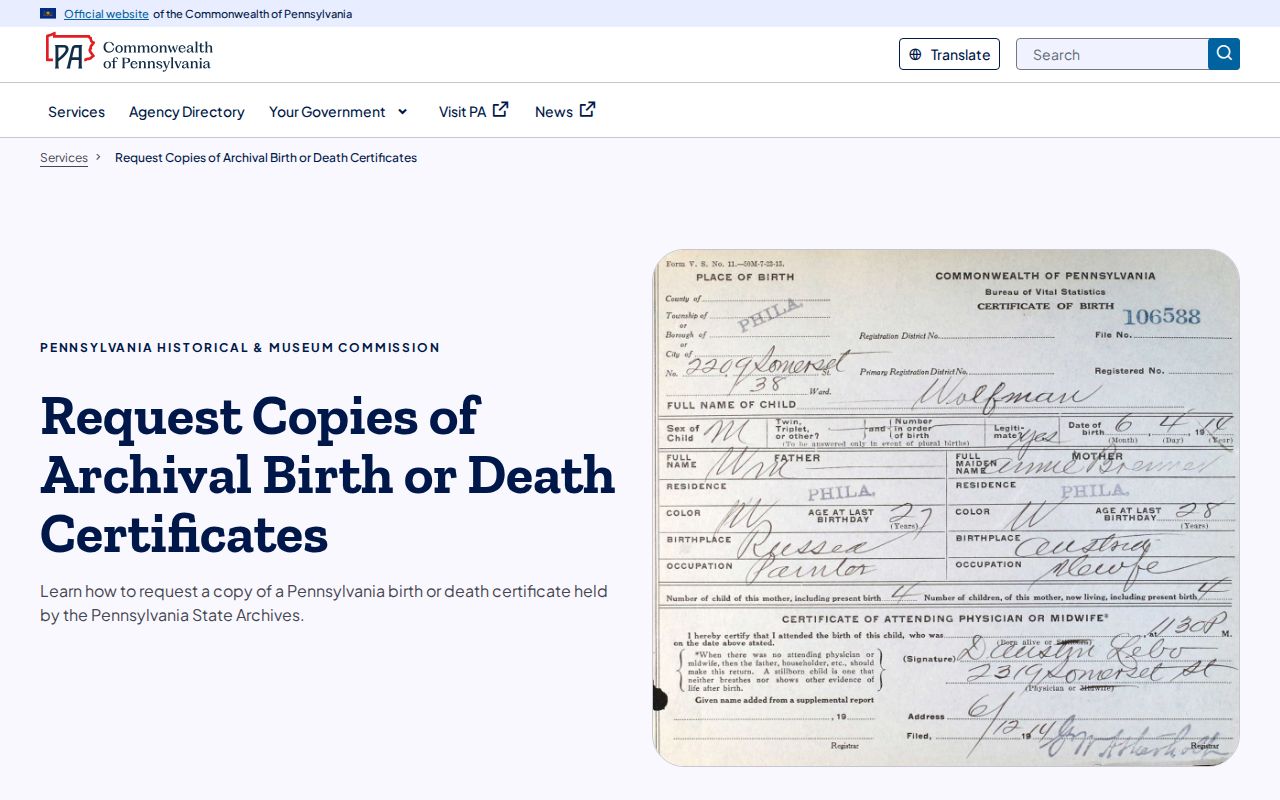
For historical material, the Pennsylvania State Archives request route is the safer current reference. As captured in the 2026 research, it covers births through 1920 and deaths through 1975, offers $5 noncertified copies, and asks for the name, date, and certificate number when known. A historical copy is a research record, not a substitute for a currently certified copy.
The State Archives historical request information explains the archive side of the date split.
For Bucks birth or death material dated 1893 through 1906, the County's genealogical and archival request route is the locally documented historical option.
PAIR and Adoption History
For adoption-related history, Pennsylvania offers the Adoption Information Registry (PAIR), a limited state program for medical and social history and contact preferences. It is not a general name search. The Department of Health separately describes the birth-parent and original-birth-record pathway under Act 127. Those official routes are better suited to this kind of family question than trying to infer a relationship from property, voter, or court records.
An estate or historical family lead has different custodians. The Bucks Register of Wills, Mercer Museum Research Library, and Bucks County Archives hold the relevant county and archival paths. Bring the Township, surname variants, a time range, and any known address or tract. Mercer has special onsite indexes that are not all online, so a specific record-group request is more useful than a broad request to identify a person.
Warrington Township Lookup Dead Ends
A no-result has several ordinary explanations. A record may use a spelling variant, another county, an older legal description, a closed vital record, a protected voter address, an unindexed historical volume, or a court class excluded from public Case Search. An old deed may identify a tract, lot, or plan rather than a modern street number. None of those conditions proves that someone never lived in Warrington Township.
Use the custodian's fallback route. For agency records that are likely to exist, Pennsylvania's Right-to-Know Law process accepts a written request that identifies the requester, mailing address, the RTKL basis, and the record with enough specificity. The Office of Open Records explains that an agency normally responds within five business days, subject to a stated extension under the law. Court, election, health, and vital material can have separate rules, so a broad request for every person at an address is not a useful substitute for a specific existing record request.
Resident Lookup Legal Limits
Pennsylvania's Address Confidentiality Program can provide a substitute address in specified court, driver and vehicle, voter, school, and marriage records for eligible participants. Chapter 67 of Title 23 includes consequences for unauthorized disclosure of a participant's actual address. Do not combine partial public details to expose a protected location. A correction also belongs with the source custodian: use the County for a tax field, the Recorder for a document issue, election officials for a voter record, and the Department of Health for a vital-record amendment.
Note: Pennsylvania's stalking and harassment statutes apply even when an address, deed, or public docket was lawfully obtained.